Leadership Lessons Learned at Cadet Officer School
By Loretta Fulton
Even Civil Air Patrol’s national commander is in awe of the cadets selected to attend the 55th Cadet Officer School this summer at National Headquarters in central Alabama.
And that’s understandable. The 119 cadets selected were the elite, from the top 15% among their peers. Maj. Gen. Regena Aye, CAP’s national commander and CEO, was one of the distinguished speakers.
“The cadets are absolutely inspiring!” Aye said. “Their dedication and passion for the program keep me motivated to serve.
“If they are examples of our future, it will be bright!”
The school was held at Maxwell Air Force Base, home to Civil Air Patrol’s National Headquarters and to Air University, the intellectual and leadership development center of the U.S. Air and Space Forces. The cadets attending represented all eight CAP regions, along with overseas squadrons in Germany and Guam.
Lt. Col. Kathleen Crockett, the activity’s co-director, said the goal was to contribute to the growth of CAP’s cadet officers “as mature leaders and responsible citizens and to introduce them to strategic thinking.”
Consider that objective accomplished, judging from the comments of six of the cadets. One, Cadet Maj. Owen Kano of the Nevada Wing’s Las Vegas Composite Squadron 70, specifically mentioned an emphasis on strategic thinking.
“I learned to see the bigger picture and understand that everything we do as officers affects the mission,” Kano said. “Timeliness, attention to detail, and situational awareness are all critical towards mission success, whatever that may look like."
Cadet 2nd Lt. Kate Porter of the Colorado Wing’s Pikes Peak Composite Squadron cited the school’s four pillars of learning — leadership, airpower, critical thinking, and communication — and addressed how one trait affects all of those.
“While it is difficult to identify one particular leadership lesson,” Porter said, “decision-making is one of the biggest takeaways, as it is required at every point during [the school].”
Civil Air Patrol is observing the Year of Ownership, which Aye emphasized in her presentation to the cadets. She reviewed ownership principles and talked about the impact the cadets can have as leaders if they embrace the concept.
“I talked about how what we tolerate as leaders becomes accepted, how leaders have to adjust to their teams and meet their needs,” she said, “and how we all have to be on the same team moving this amazing organization forward to succeed.”
Cadets, in their own words, expressed their thoughts on leadership:
Cadet Maj. Aleigha Hornsey of the Oklahoma Wing’s Broken Arrow Composite Squadron
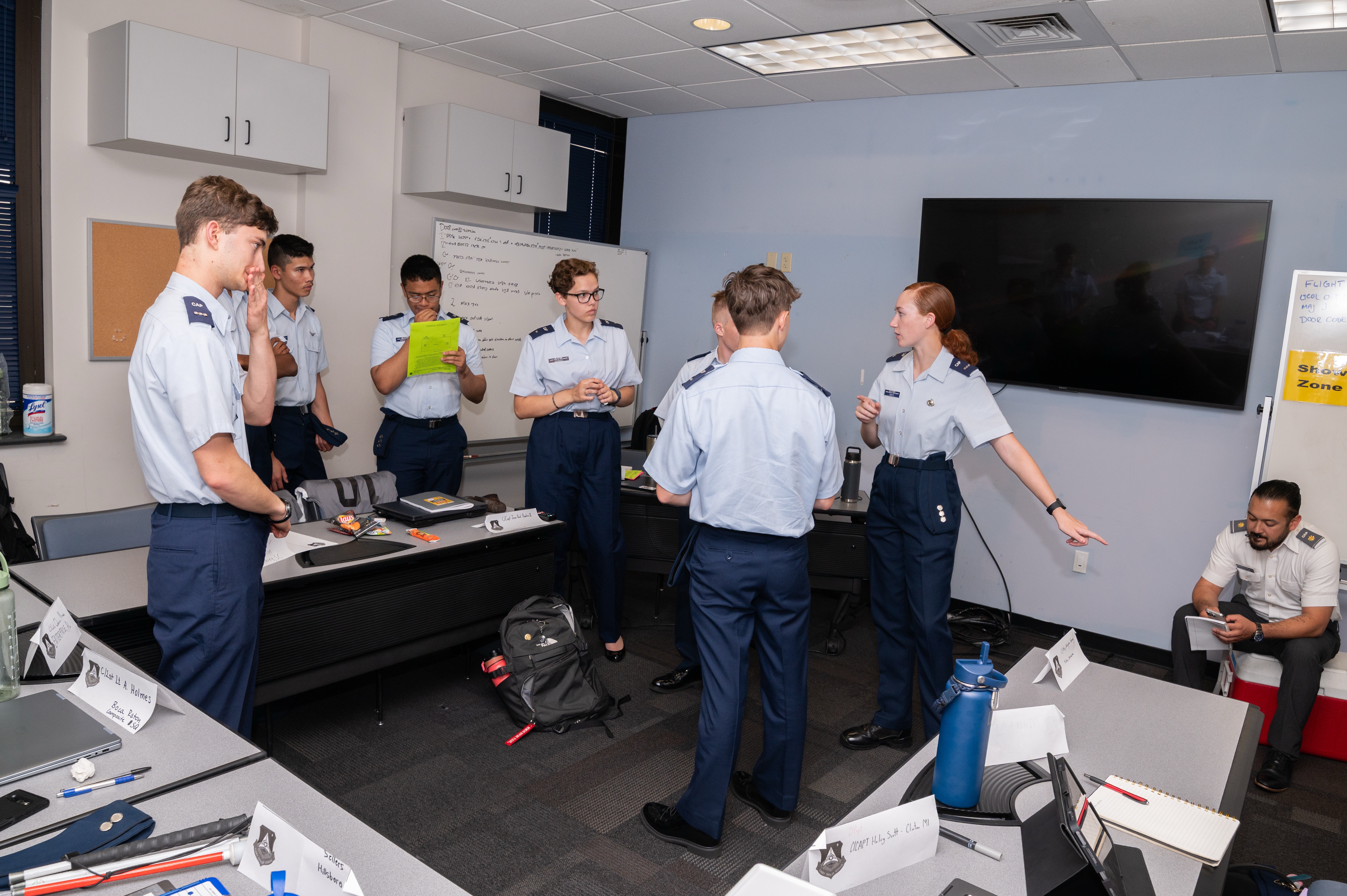
Cadet Maj. Aleigha Hornsey (in front of the white board) participates in a group discussion. This photo and others in this story were taken by Maj. Steve Lampasona, Florida Wing.
“I learned that my expectations often did not align with reality, which led to conflict — whether in the sense of personality clashes or just something not going as planned.
“The most impactful lesson I learned ... was how my response to conflict affected my team. I have always known that I disengaged in high conflict, but at [Cadet Officer School] I saw how this related to my leadership. Challenging situations, along with feedback from my flightmates and instructors, helped me realize that disengaging in conflict left me unhelpful during important problem solving.
“Now I know where to seek improvement in my leadership.”
Cadet Maj. John Baruth of the Ohio Wing’s Licking County Composite Squadron
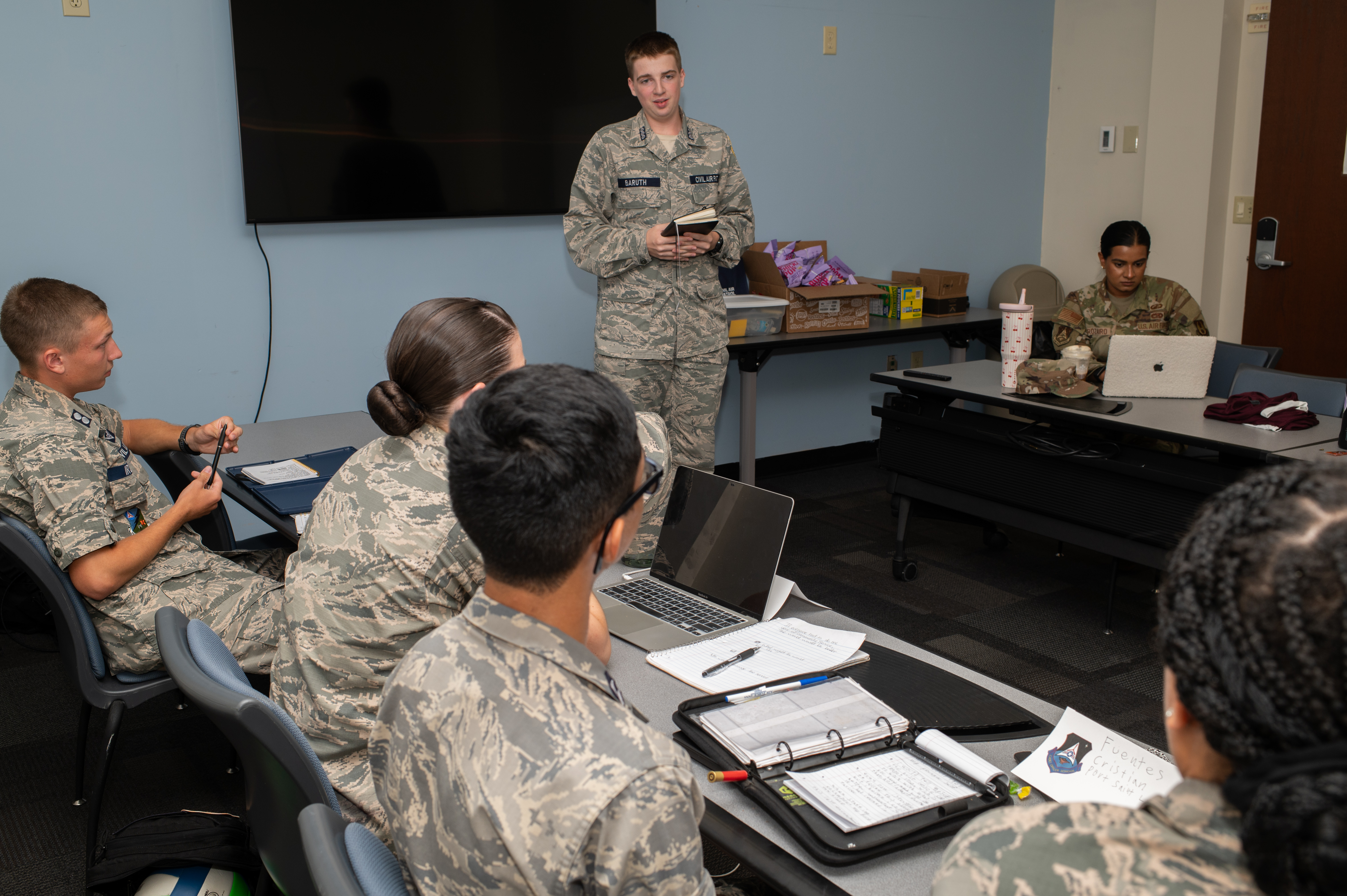
Cadet Maj. John Baruth leads discussions in his group at Cadet Officer School.
"Cadet Officer School demonstrated to me that effective military leadership blends the authority of rank with intellectual engagement and humility.
“Whether it be my instructors, flight leaders, or flightmates, I observed leaders who earned respect through their actions, not just their authority. They demonstrated critical thinking, adaptability, and the ability to connect with others, qualities that enhanced my perspective on what it means to be an officer.
“These lessons will guide me as a cadet officer in CAP and carry forward into my future military career, where I aim to lead with both authority and understanding.”
Cadet Maj. Owen Kano of the Nevada Wing’s Las Vegas Composite Squadron 70
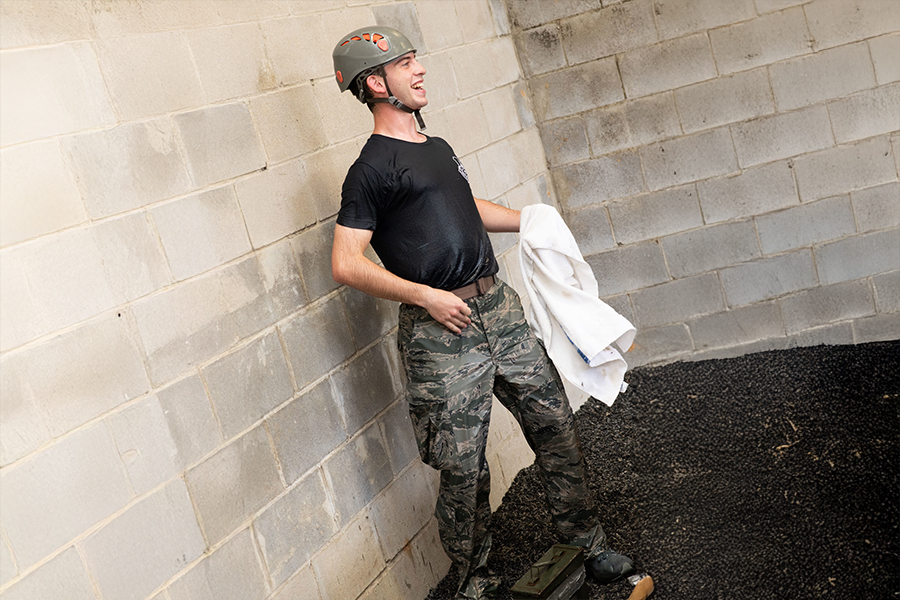
Cadet Maj. Owen Kano awaits his turn at Project X, a reaction training course at Maxwell Air Force Base that teaches problem solving, teamwork, and leadership skills.
"Aside from learning how to play volleyball or perform Team Leadership Problems, [Cadet Officer School] taught me to view problems strategically.
“Leadership is a sacrifice that requires the officer to give of themselves completely toward the mission and the team. Every leader is first and foremost a follower to the demands of the mission and needs of his or her team.”
Cadet 2nd Lt. Kate Porter of the Colorado Wing’s Pikes Peak Composite Squadron
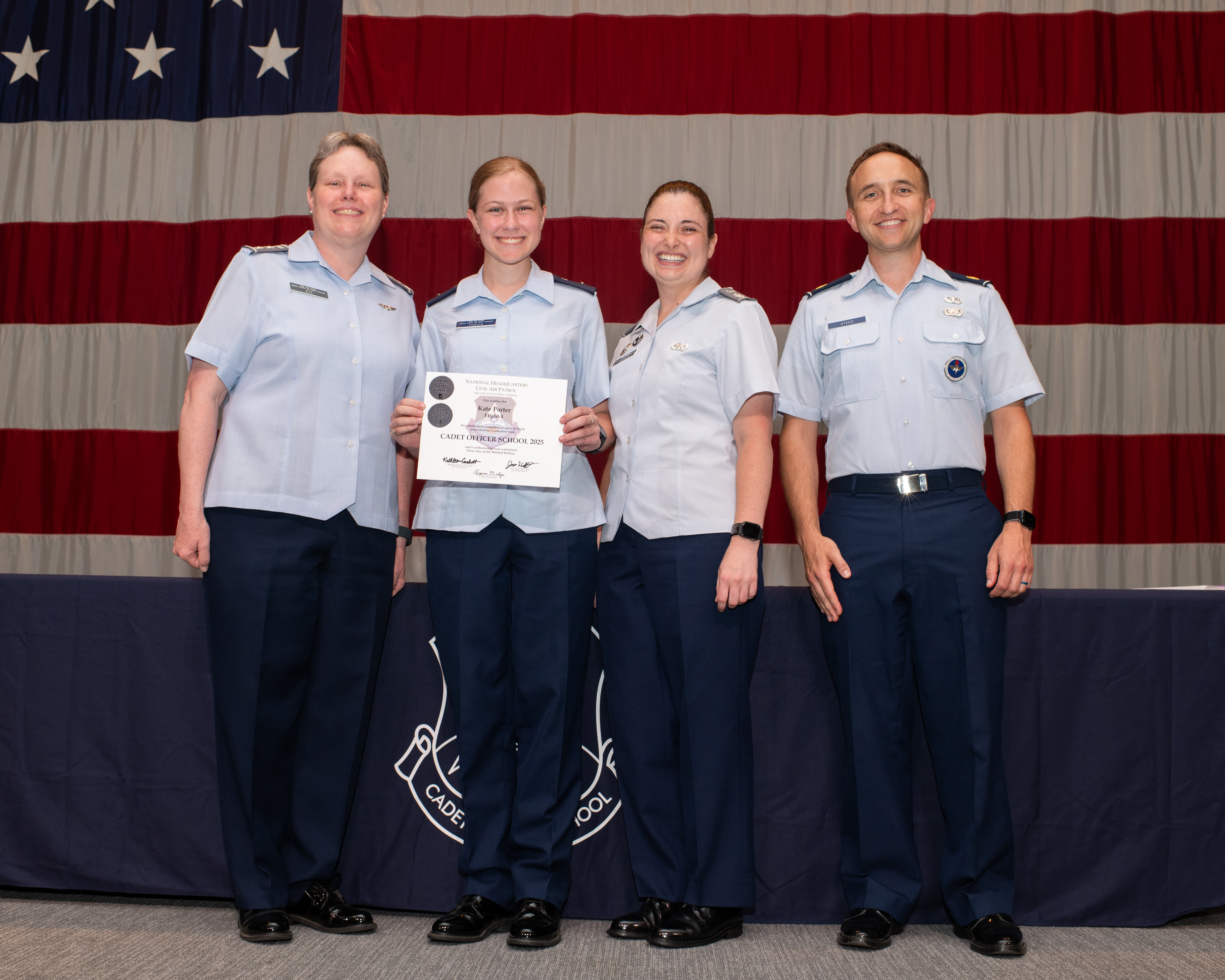
Cadet 2nd Lt. Kate Porter, second from the left, holds her graduation certificate alongside (from left) Maj. Gen. Regena M. Aye, CAP’s national commander, and co-activity directors Lt. Col. Kathleen Crockett and CAP-U.S. Air Force Maj. Jason Steed.
“Decision-making requires critical thinking. Critical thinking is not only thinking three steps ahead, but, as one speaker defined it, 'Critical thinking is thinking about the quality of your thinking.' This influences every decision you make. When your thinking is of the highest quality, your decisions will produce quality consequences. This was reinforced throughout [Cadet Officer School] not only in the discussions we had on leadership, airpower, and communication but through hands-on experiences.
“My flight in particular learned the importance of quick decision-making and timely action during Team Leadership Problems and Project X. This truly enhanced the curriculum, as making mistakes in a hands-on environment cemented those lessons. [Cadet Officer School] is more than just a leadership [national cadet special activity]; it is a transformational experience that equips Civil Air Patrol’s finest cadet officers with the skills necessary to serve their community, state, and nation effectively.”
Cadet Lt. Col. Adrian Salonga of the Ramstein Cadet Squadron in Germany
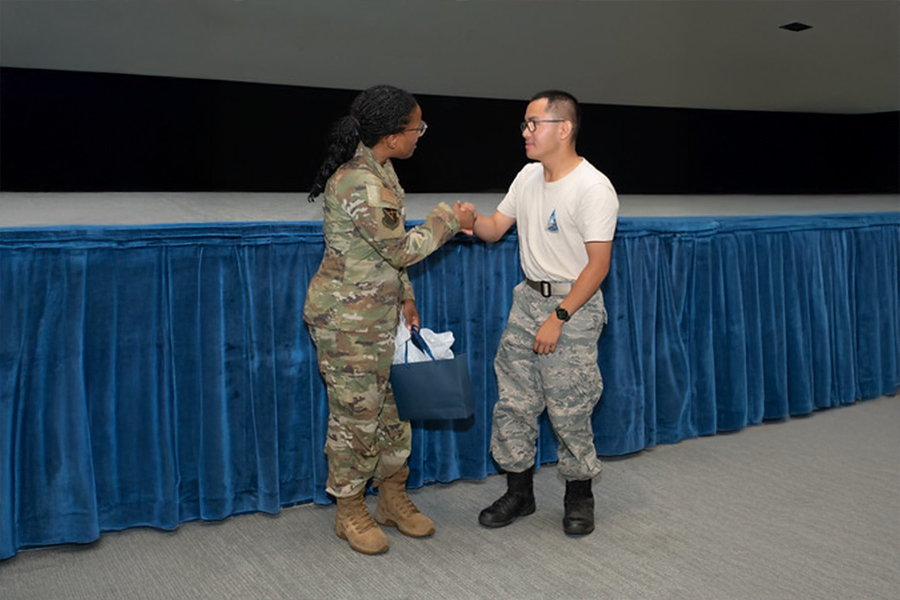
Cadet Lt. Col. Adrian Salonga (right) chats with one of the guest speakers at Cadet Officer School.
“What I learned from Cadet Officer School was being able to mentor and solve problems with my peers and foster a healthy environment for discussion.
“Throughout the week, my flight had Team Leadership Problems, which were scenarios that had obstacles that the team had to overcome. In order to solve the [problems], team members had to be open-minded toward others’ opinions and be flexible in order to get the job done. After the [problems], we also had group debriefs in order to articulate what did or did not work about our strategy so that we could improve.
“The experience reinforced my belief that collaboration is a vital life skill.”
Cadet Maj. Elyes Beloulehi of the Florida Wing’s Fort Lauderdale Composite Squadron
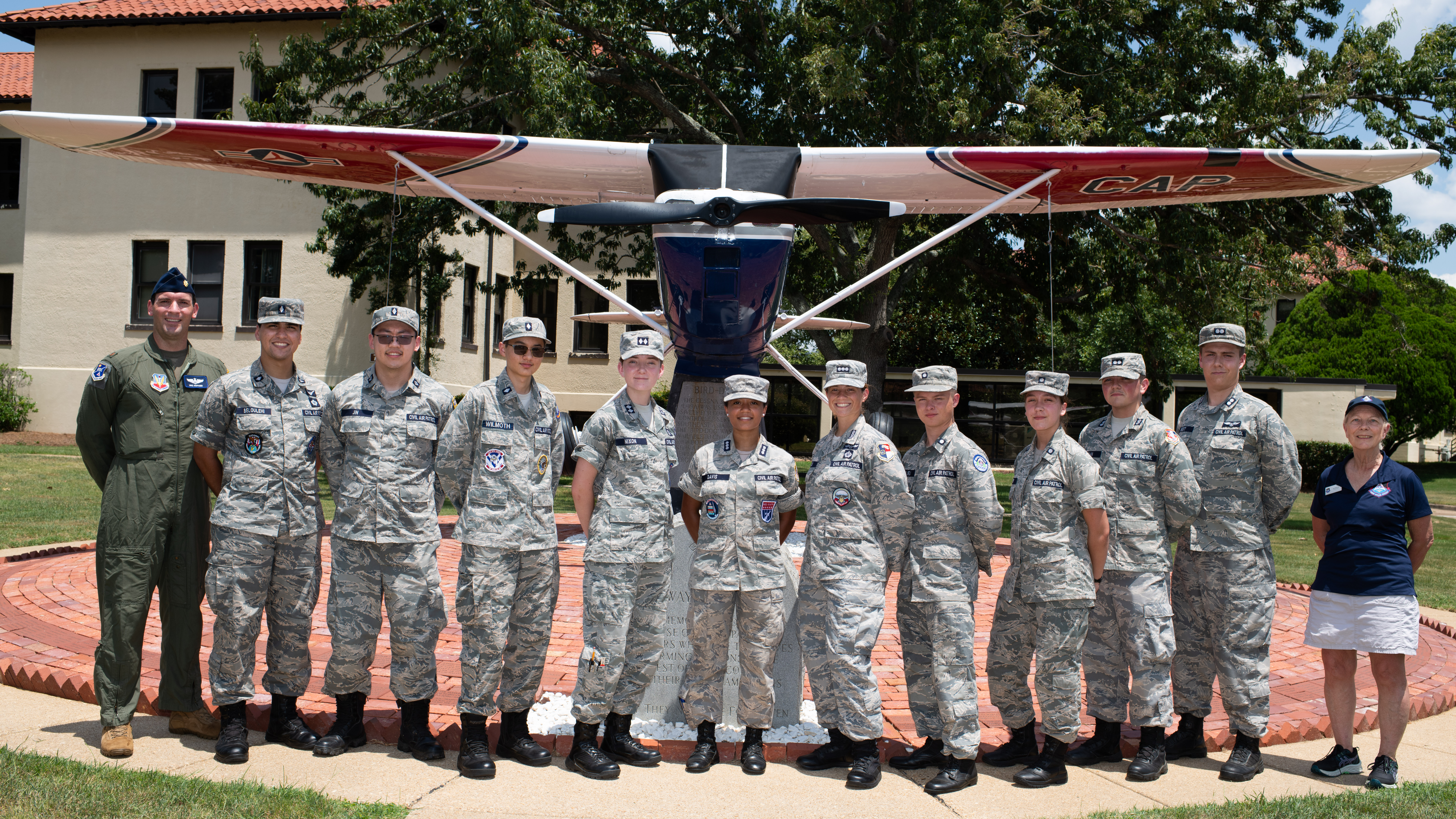
Cadet Maj. Elyes Beloulehi, second from left, poses for a group photo with her Flight 5 classmates.
“At Cadet Officer School, I learned that a strategic leader must view both the present and future from a broad perspective, identifying patterns in actions to guide their team effectively.
“Rank did not matter; we were all students learning together. This environment emphasized the importance of teamwork, humility, and adaptability when working with peers.
“One of my greatest takeaways is the ability to collaborate with others of equal standing and to navigate tensions that may arise, whether between flight commanders in a squadron or coworkers in a professional setting, turning potential conflict into meaningful growth.”