CAP Supports Mission to Bolster Security at U.S. Southern Border
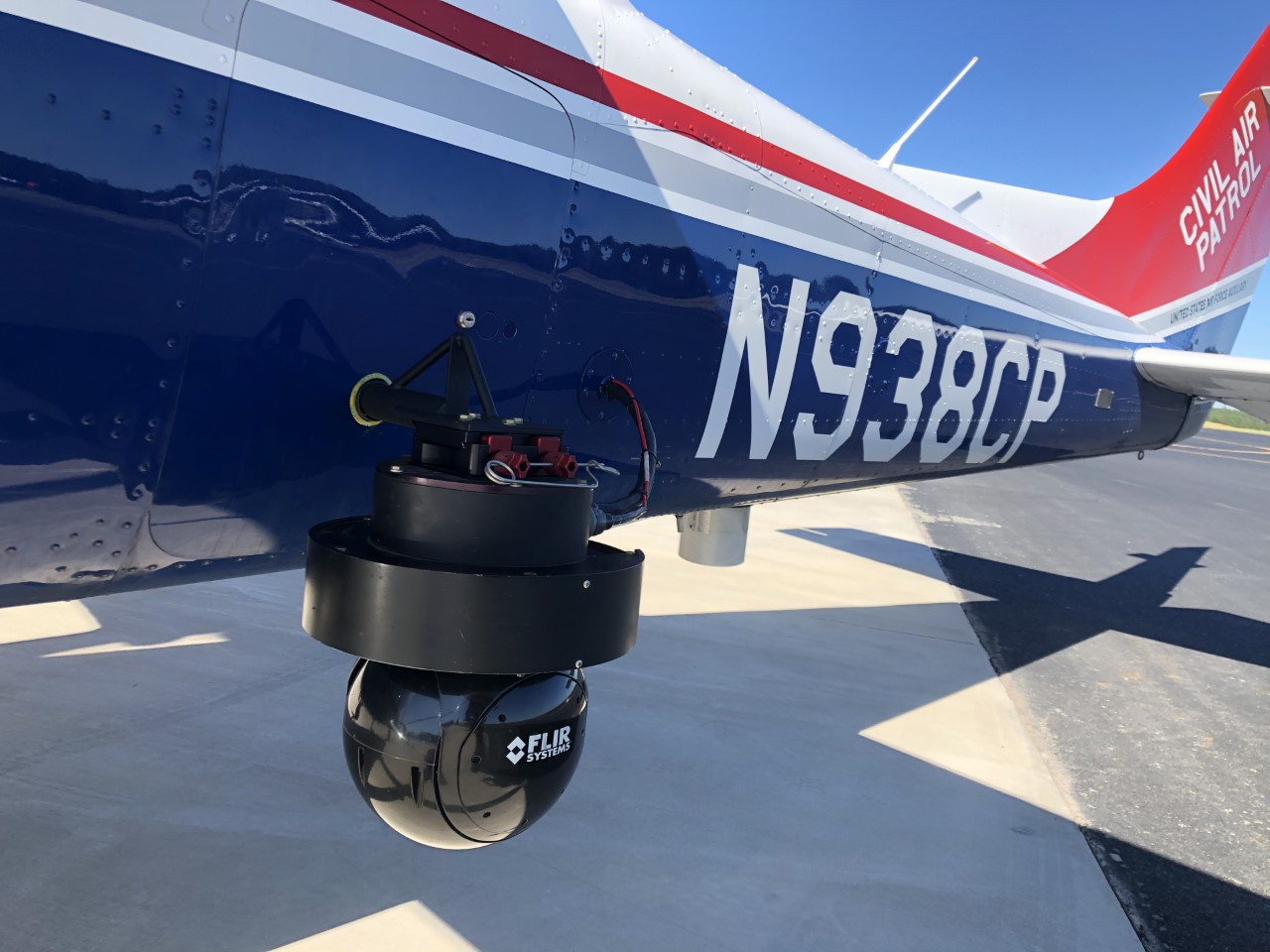
A forward-looking infrared (FLIR 8500) camera is installed on this CAP aircraft. Advanced airborne technologies like FLIR are being considered for future border missions.
For more than three decades two Civil Air Patrol regions and four wings have flown thousands of daily missions to bolster security at the U.S. southern border.
These missions harken back to CAP’s heritage of helping protect the nation’s approaches from potential illegal activities and passing on the vital information to the proper authorities. CAP continues the effort alongside agents from U.S. Customs and Border Protection as an integral part of U.S. Northern Command and its mission.
Acting in its role as the U.S. Air Force auxiliary and a Total Force partner, CAP is serving as a force multiplier, working shoulder-to-shoulder with federal law enforcement agencies, including the Department of Homeland Security and Customs and Border Protection. Under the direction of Joint Task Force North and the newly formed Joint Task Force Southern Border, CAP, along with other joint partners, focuses on identifying and relaying positions of cross-border traffic in Arizona, California, New Mexico, and Texas.
Each week CAP wings add sorties to the First Air Force Air Tasking Order. These flights occur in priority areas set by the experts at CBP to augment and enhance the work of DHS and CBP to detect and monitor cross-border activity.
On these missions, specially selected and trained CAP members fly to areas of suspected high traffic or known crossing areas and monitor and report activity they see back to the ground agents. Often CAP assets are used when more expensive assets are not available or during periods they cannot fly due to downtime or maintenance activities.
Each CAP operating location provides a situation report when activated, detailing numbers of missions, sorties, and flying hours to detail the organization’s support of the border protection mission.
Today, the southern border may be attracting a little less interest in the press, as migration has slowed in recent months. CAP, though, isn’t backing down or reducing its support for the mission.
In fact, with new support from the Department of Defense to augment DHS in border security, CAP is looking at additional activities and locations to increase its footprint as well as adding enhanced capabilities into the effort.
According to Terry McCaffrey, CAP’s director of operations, “Although we have relied on the ‘Mark-One-Eyeball’ of CAP members over the past many years to spot activity, CAP is looking at applying advanced airborne technologies and systems like our limited number of Forward Looking Infra-Red [FLIR]-equipped aircraft to join the mission.”
McCaffrey said these systems are more than just useful in search and rescue or disaster response. They allow CAP to provide enhanced video support to the CBP mission both during the day and after the sun goes down. CAP can provide real-time video downlinks to agents on the ground to help better identify location, movement, and activities of potential threats, giving CBP agents more information and ability to safely do their job in protecting the nation.
Over the last eight fiscal years, CAP has averaged about 3,100 flying hours annually in support of the DHS’ drug interdiction mission. In the fiscal year that just ended, 269 CAP members flew more than 3,150 hours on more than 1,325 sorties to support this critical mission.