Solo Success in the Skies
For Aspiring CAP Cadet Aviators, Ayres Flight Academy Helps Dreams Come True
By Paul South
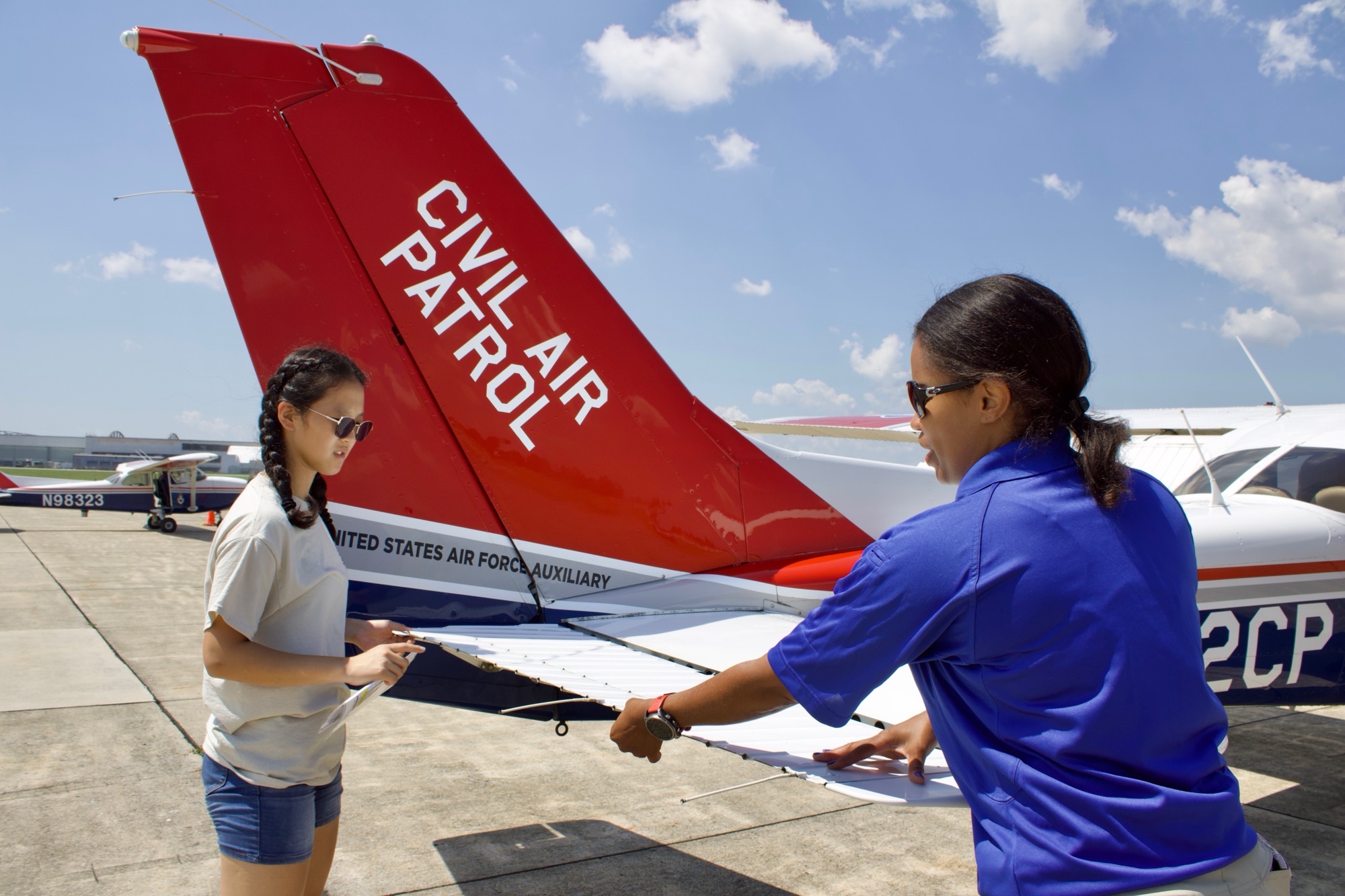
Capt. Eryka Xavier Da Silva, an academy instructor, conducts a preflight walk-through with Cadet Chief Master Sgt. Peony Kang.
It began in 1990 in Hagerstown, Maryland. Thirteen Civil Air Patrol cadets with 13 keen minds and 13 hungry hearts, all holding fast to one dream:
Flying solo, following the figurative contrails of aviators like Amelia Earhart, Brig. Gens. Billy Mitchell and Chuck Yeager, and countless other U.S. military, commercial, corporate, or private pilots.
Solo success stories are written every summer at CAP’s 14 national flight academies, intended to provide cadets with aviation education, confidence-building, and leadership development. Soloing is an important milestone for some, but the true measure of success is the growth in knowledge, skills, and character that all cadets experience. Hagerstown’s Lt. Col. Robert Ayres Memorial National Flight Academy is special.
Ten cadets were chosen for the 2025 academy. They received not only 15 hours of flying time but also ground school instruction. Before arriving, they completed two weekends of ground school before they even saw an aircraft.
It’s about more than time in the cockpit. Cadets also prepare to pass the Federal Aviation Administration’s written test.
Applicants compete for the program based on their Civil Air Patrol record, academic performance, an essay, resume, and an in-person interview. All have demonstrated their commitment to the cadet program, said Lt. Col. John Henderson, director of the Ayres academy. Applicants must be at least 16 years old.
This year, 45 cadets from up and down the Eastern Seaboard and from as far west as Chicago applied. In the past, cadets from as far away as Alaska and Hawaii have done so.
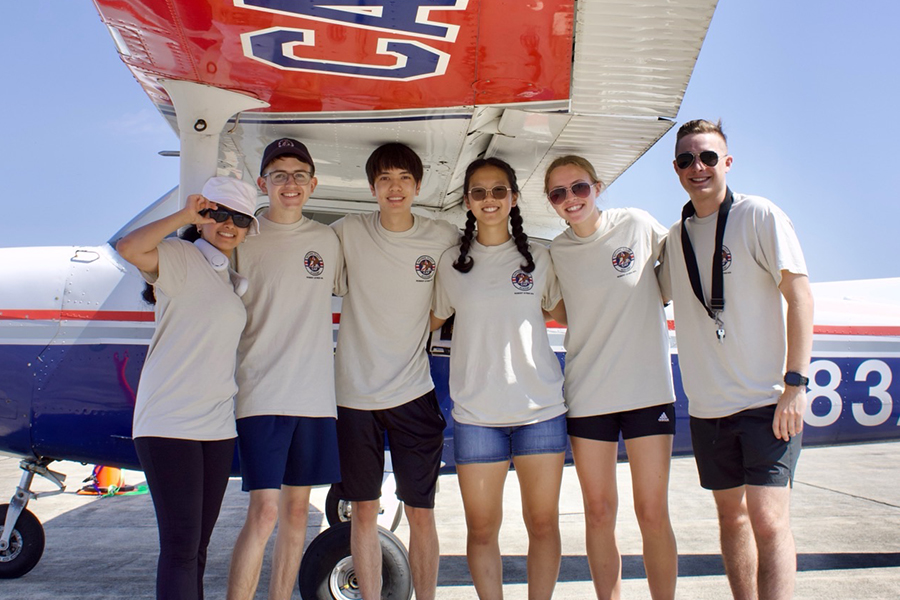
Cadet Majs. Anvita Kulkarni and Casey Golladay, Cadet Tech. Sgt. Thien Le, Cadet Chief Master Sgt. Peony Kang, and Cadet 1st Lts. Elsa Gustafson and Ethan Anguiano were students at the 2025 Lt. Col. Robert Ayres Memorial National Flight Academy.
Kimberly Carole, CAP’s deputy director of government affairs, said she’s a big fan of the academy. She has visited the academy several times to capture dynamic photographs for high-level briefings.
“My particular interest in the [academy] is its ingenuity in terms of extreme resourcefulness that is akin to the sacrificial crisis mindset of the early CAP volunteers prior to and during World War II,” Carole said. “Its lean budget, overarching objective, and concept of operations, the cadre of devoted professionals, and the rallying of local members providing direct support make it unique even in CAP.”
She added, “CAP volunteerism is cost-effective in every domain. Its resourcefulness, the drive for mission success, and patriotism are reminiscent of stories heard among the Greatest Generation. The [academy] emulates that mindset. This type of ingenuity is woven into the fabric of CAP’s volunteerism and greatly amplifies the return-on-investment for Capitol Hill.
“They are celebrating 35 years of success.”
Instructors and staff give the cadets 110%, Henderson said.
“I think the biggest thing that makes the activity so successful is the staff and the instructors,” he said.
And there are the cadets. A tenth of a point on application scores sometimes separates successful applicants.
“All the cadets who applied this year had 4.0 GPAs. They were all phenomenal cadets in the program. That’s what we see,” Henderson said. “The phenomenal cadets we have applying — coupled with the awesome staff that I’ve got — that’s what makes this thing go.”
A counterweight to the pressure of flying is that Henderson and the staff work to create a relaxed atmosphere for the young participants.
And while the goal is for every Ayres cadet to solo and pass the FAA exam, that doesn’t always happen. Even so, the academy staff doesn’t abandon those students. The investment in every student continues, Henderson said.
“For the cadets who do not achieve one or both of those benchmarks, our staff will continue to work with them to help them achieve success in their home units when they return,” he said. “We want to see them succeed, so we do whatever we can to encourage them to keep going and to complete what they set out to do.”
The academy is named for the late CAP Lt. Col. Robert Ayres, who created what was formerly known as the Maryland Wing Solo School. He passed away in 2012.
What would Ayres think today about the academy that bears his name and attracts some of Civil Air Patrol’s best and brightest cadets?
From the outside, some — even fellow cadets and adult CAP members — might see that first solo as “cool,” but that’s missing the blood, sweat, tears, and other emotions, as well as the hard work cadets and their instructors pour into the academy, Henderson said. Staff commitment is the “secret sauce” behind the academy’s success.
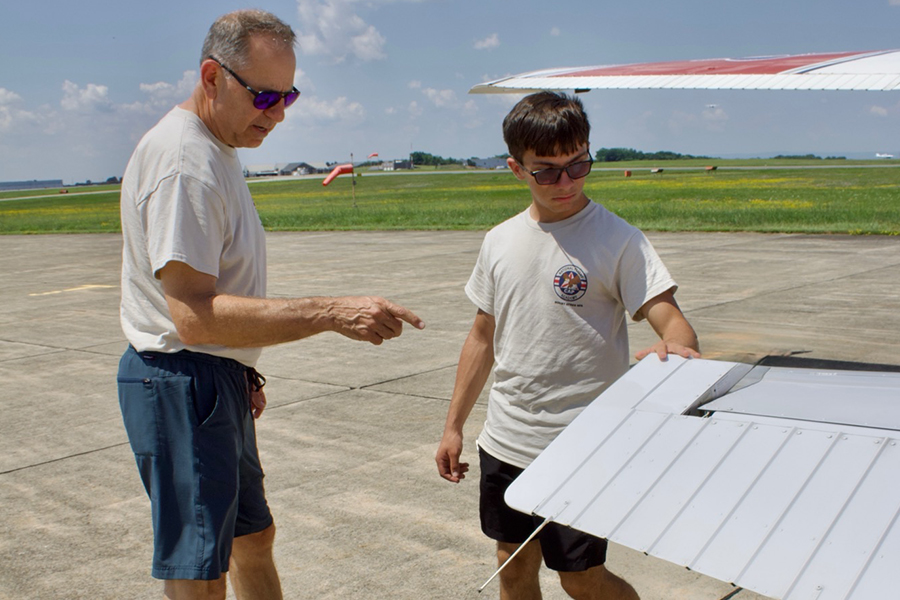
Maj. Martin Sacks, a flight instructor at the academy, and Cadet Capt. Nicolas Guzman-Spath take a closer look at the wing of a CAP aircraft before takeoff.
The future of aviation is being shaped at the academies. Past students have become U.S. Air Force, U.S. Navy, and U.S. Coast Guard pilots, flying F-4s, F-15s, F-16s, C-5s, C-17s, and the like. Others fly for corporate outfits like FedEx. Still others will become airline pilots or adult CAP flyers.
After 35 years, what’s the legacy of the Ayres academy?
“Seeing these cadets succeed and following their lives and hearing how they are doing really makes it worthwhile,” Henderson said.
“Over 300 cadets have been introduced to aviation and are now in successful careers,” he said. “Each one of these cadets will leave our academy and become ambassadors not only for the Robert Ayres (academy) but for Civil Air Patrol and aviation in general. This is how you prepare for the future; you build ambassadors who recognize the value and spread the word.
“This is better than any PR campaign you can design.”
For cadets at Ayres, the future, like visibility on a crystal-clear day, is unlimited. That means bright days ahead for American aviation, not to mention related STEM and leadership careers.
“These are our future Top Gun aces, our future defenders of freedom, our trusted agents to take us and our kids on family vacations,” Henderson said. “This is the start of not only an adventure but more like a calling to do what they feel they would like to dedicate the rest of their lives to.”
He added, “Leonardo Da Vinci said it best: ‘When once you have tasted flight, you will forever walk the earth with your eyes turned skyward, for there you have been, and there you will always long to return.'”
The participating cadets this year were:
Delaware Wing
Delaware Air National Guard Cadet Squadron | Cadet Capt. Nicolas Guzman-Spath
Maryland Wing
Bethesda Chevy Chase Composite Squadron | Cadet Tech Sgt. Thien Le
Carroll Composite Squadron | Cadet Chief Master Sgt. Peony Kang
Col. Mary S. Feik Composite Squadron | Cadet 1st Lt. Elsa Gustafson
Granite Cadet Squadron | Cadet Maj. Casey Golladay
New Jersey Wing
Allentown Composite Squadron | Cadet Maj. Anvita Kulkarni
Maj. Thomas B. McGuire Jr. Composite Squadron | Cadet Lt. Col. Nathaniel Hawkins
North Carolina Wing
Guilford Composite Squadron | Cadet 1st Lt. Ethan Anguiano
Virginia Wing
Leesburg Composite Squadron | Cadet Capt. Kai Posey
Winchester Composite Squadron | Cadet Maj. Benaiah Lichti